Café Curtain Rod Buying Guide
Meet our collection - and we couldn't be prouder of it.
Which café curtain rod do I need?
The right café curtain rod makes more difference than you'd think. Get it right and the hardware disappears into the window, or it becomes part of the look, depending on what you choose. Get it wrong and even the most perfect café curtain can sit awkwardly.
There are really only two decisions to make: where the rod fixes, and what it's made from. Here's how to work out both.
We've spent months searching out the best variety of rods for our customers. Our specialty is breadth of range - whatever your window, budget or style, there's something here for you.
Face fix or side fix?
This is the decision that matters most, and it comes down to where the bracket sits.
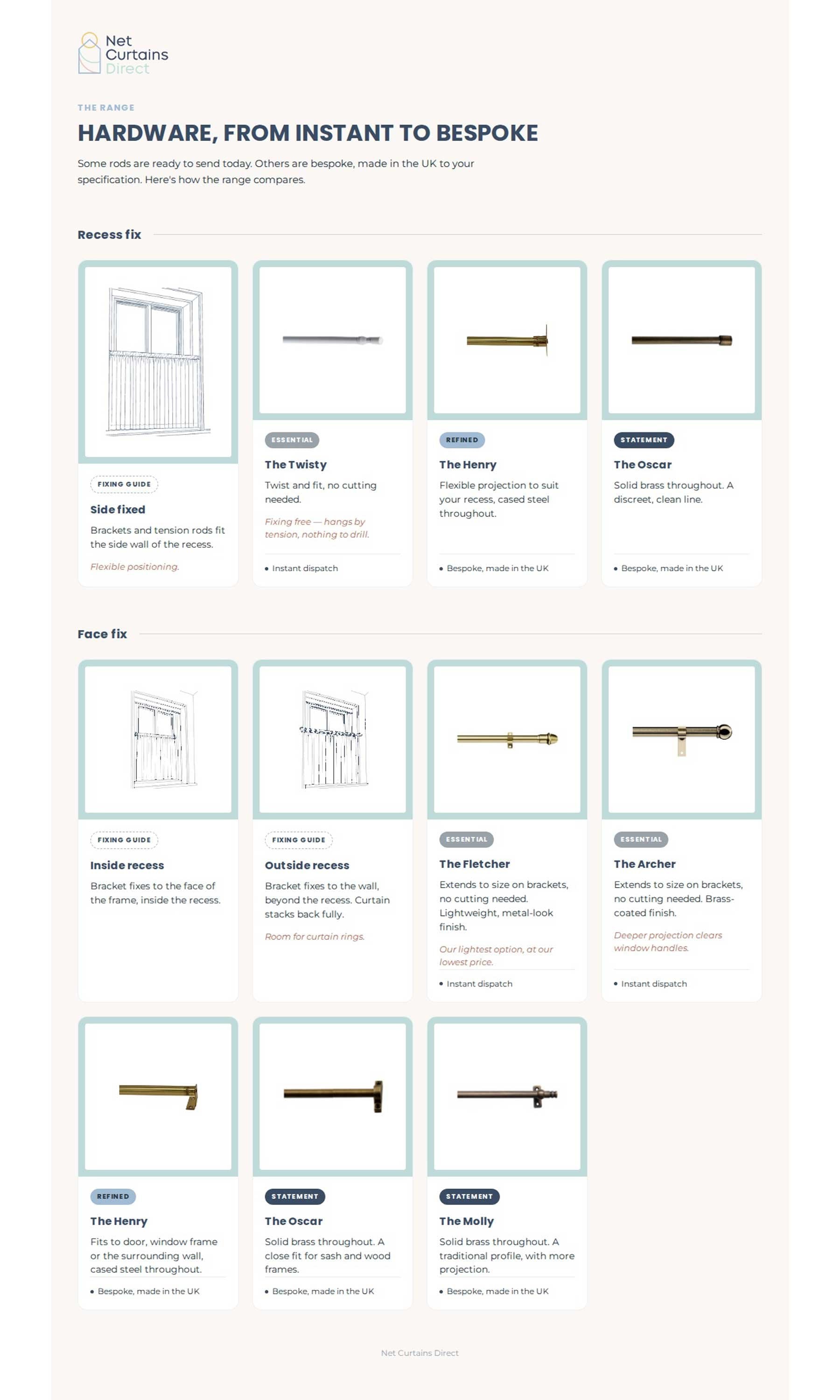
Side fix fixes to the side wall, with the rod spanning the full width of the frame. Unlike face fix, you choose exactly how close to the glass it sits - handy if window handles are in the way, or if your windowsill holds ornaments that need the room.
Face fix mounts to the face of the window frame - a sash window is the prime example, or anywhere you'd like to give the illusion of one. It doesn't need to span the entire window, which is great if you'd like some of the frame or glass left on show. Face fix also works well for door or cabinet curtains. A rod like The Oscar sits neat and close to the frame - ideal for slot top & bottom curtains.
Plastic, metal, brass-coated, or solid brass
Once you know where it fixes, the next question is what it's made from. This is where the price bands come from, and each one is a genuinely different material, not just a different price tag on the same rod.
Plastic. The Extendable Net Curtain Rod extends to size on brackets, with no cutting needed, in a lightweight plastic finish. Ready to send today, and the most affordable option in the range.
Metal. The Twist & Fit Tension Rod is powder-coated aluminium - a tension rod with no drilling, no brackets, nothing to fix in place. It twists to hold itself in the recess, and comes out just as easily - handy for readjusting, or for taking the curtain down for a regular wash. The 9-11mm Extendable Cafe Rod and the 10-13mm Extendable Metal Cafe Rod both have a metal rod with a mix of metal and plastic finials, and extend to size on brackets with no cutting needed; the 10-13mm has a brass-coated finish and a deeper projection that clears window handles. All three are ready to send today.
Brass-coated steel. The Henry is steel with a genuine brass coating - hollow rather than solid, which is what keeps the cost below solid brass. Being hollow also makes it noticeably lighter, which has its own upside: it's easier to handle when fitting, especially on longer bespoke lengths. As a made to measure café curtain rod, cut to your exact specification rather than off the shelf, it offers flexible projection to suit your recess as the Henry Side Fix, or fits to door, window frame or the surrounding wall as the Henry Face Fix. Bespoke, made in the UK.
Solid brass. There's a difference you feel the moment you pick one up - the weight of it in your palm, the way it doesn't flex or give, the sense that it's built to last. The Oscar and The Molly are solid brass throughout, in a choice of finishes, and neither is trying to disappear: this is a rod worth having on show, not hidden away. The Oscar gives a close, discreet fit; The Molly has a traditional profile with more projection. Both are hand-finished to order - polished brass is hand-buffed to its shine, and antique finishes need an extra treatment step to achieve their aged patina, which is part of why they take a little longer to arrive. Bespoke, made in the UK - browse the full Café Rods range to see every finish, along with matching rings, centre supports and other accessories.
As a rule, moving up through these bands buys you two things: a heavier, more solid feel in the hand, and a finish built to last indefinitely rather than one that could eventually wear through to the metal beneath - since solid brass has no coating to wear through in the first place. How much the weight matters depends on how much of the rod you'll actually see, which loops back to the side-or-face decision above. Longevity is worth weighing on its own terms, whichever way you fix.